Many companies invest in website design, choose attractive images, and organize their pages well, but forget one essential part: the text. In practice, written content is often what makes the difference between a visitor who leaves and a visitor who moves toward contact.
A website can look visually professional and still fail to generate inquiries, leads, or clients. This happens when the copy is vague, overly institutional, or not oriented toward the visitor’s decision-making process.
Writing website copy that converts does not mean “writing beautifully.” It means communicating clearly, showing value, reducing doubts, and helping the visitor take the next step.
To better understand the broader context of this topic, this page can connect to the main cluster article:
How to Plan a Business Website That Generates Leads and Clients
Why website copy affects conversion so much
When someone lands on a business website, they are not looking for generic phrases. They want to quickly understand whether that company understands their problem, offers the right solution, and feels like a safe choice.
This is where copy matters.
Good images help. Clean design helps too. But it is the text that explains, guides, persuades, and reduces uncertainty. When the copy is clear, reading flows naturally and the decision becomes easier. When the copy is confusing, full of vague promises, or too focused on the company itself, trust starts to drop.
That is why writing well for a website means writing with commercial intent and with a clear focus on the visitor.
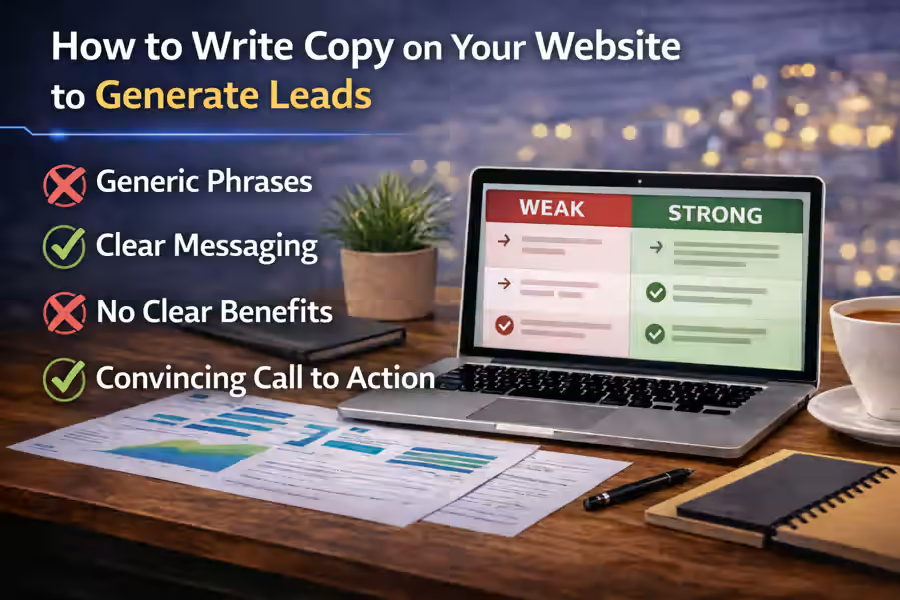
The most common mistake: writing for the company, not for the client
One of the most frequent problems on business websites is overly institutional language. The company talks about itself all the time: its history, its values, its mission, its experience. All of that may have its place, but it should not dominate the communication.
What the visitor mainly wants to understand is this:
- what problem the company solves;
- who the service is for;
- what result they can expect;
- why they should trust the company;
- how they can move forward.
When the copy answers these questions, the website becomes more useful and more persuasive. When it does not, the visitor feels that the content is talking “about the company,” but not “to them.”
Clarity matters more than sophistication
Many companies believe professional writing needs to sound complex. In practice, the opposite is true.
A website that converts usually uses simple, direct, and clear language. That does not mean writing poorly. It means writing in a way that is easy to understand.
Phrases such as:
- “innovative solutions for digital growth”
- “excellence and commitment to results”
- “personalized responses to market needs”
may sound professional, but they say very little.
Instead, it is better to write something concrete, such as:
We create business websites for companies that want to generate more leads and present their services more clearly.
This kind of message is stronger because it communicates something real, immediate, and easy to understand.
The visitor should quickly understand what the company does
The first few seconds are critical. If the visitor does not quickly understand what the company does, the chances of leaving are high.
That is why the most important copy on the website, especially on the homepage and service pages, should answer the essential questions right away.
A good formula is:
- what the company does;
- for whom;
- with what benefit.
This principle is especially important on the homepage. To go deeper into this point, this page can link to:
How to Create a Homepage That Leads the Client to Take Action
Write headings that guide the reader
A good website does not depend only on strong paragraphs. It also depends on good headings and subheadings.
Headings help the visitor “scan the site at speed.” Many people do not read every word. They move their eyes through the blocks, evaluate the headings, and decide where to focus attention.
That is why headings should be clear, specific, and useful. Instead of vague headings such as “Our approach” or “What makes us different,” it is better to use headings with more intent, such as:
- How our process works
- What is included in this service
- Why clients choose this solution
- What happens after the first contact
The clearer the heading, the easier it is to guide navigation and understanding.
Every page needs a writing goal
Website copy should change depending on the role of the page. A common mistake is using the same tone and structure everywhere, without respecting the intent of each section.
For example:
- the homepage should present and guide;
- the service page should explain and persuade;
- the about page should build trust;
- the contact page should make action easier;
- articles should educate and direct.
When the copy matches the role of the page, the website becomes more coherent and stronger from a commercial point of view.
This topic is also connected to the overall site structure:
How to Structure a Business Website to Generate More Inquiries
Talk about benefits, not only features
Another common mistake is describing the service only through its technical features.
For example, saying that a website is “fast, responsive, and modern” may be correct, but it still does not clearly show the value for the client. Those features need to be translated into real benefits.
Example:
- feature: responsive website
- benefit: the client can browse comfortably on mobile, which increases the likelihood of contact
- feature: simple content management panel
- benefit: the company can update content without always depending on technical support
- feature: optimized structure
- benefit: the website becomes clearer for users and has a stronger foundation for SEO
Visitors respond better when they understand how the solution helps them in practice.
The copy should remove doubts before they block the decision
Copy that converts is not only meant to “sell.” It is also meant to remove objections.
Very often the visitor is interested, but still has questions such as:
- is this suitable for my type of business;
- how long does it take;
- how does the process work;
- will I get support;
- what is the next step;
- do I need to prepare anything.
If the website ignores these doubts, the person delays contact. If the copy anticipates and answers them clearly, the decision feels easier.
That is why strong commercial copy has a strategic function: it reduces friction.
Trust signals should appear alongside the message
Good copy becomes even stronger when it is supported by trust signals. It is not enough to say that the company is good. It is better to support the message with elements that make it credible.
For example:
- short testimonials;
- project examples;
- relevant numbers;
- explanation of the process;
- names of clients or industries served.
When copy and trust appear together, the communication becomes much stronger.
This point can be explored further in:
What Trust Elements Should a Business Website Have
CTAs should be direct and natural
Website copy needs to lead to action. That means every important page should include clear calls to the next step.
Some examples of effective CTAs:
- Request a Quote
- Get a Proposal
- Talk to Our Team
- Book a Meeting
- Send an Inquiry
The mistake is using CTAs that are too vague or passive, such as “Learn More,” when the real purpose of the page is to generate contact.
The CTA should match the visitor’s stage in the decision process and the goal of the page.
Less useless text, more useful text
Having more text does not mean communicating better. In fact, many pages convert worse because they are full of long, repetitive blocks with little real value.
Strong website copy usually has these characteristics:
- relatively short sentences;
- clearly separated ideas;
- concrete language;
- focus on problems and solutions;
- subheadings that help readability;
- less institutional, more useful.
The goal is not to “fill the page.” The goal is to make understanding and decision-making easier.
Service page copy is especially important
Service pages are often among the pages with the biggest commercial impact on the site. That is why the copy here needs to be especially well developed.
A good service page usually explains:
- what the service is;
- who it is for;
- what problem it solves;
- how it works;
- what results it can bring;
- how to request a quote or move forward.
If the company works in areas such as website creation, for example, this logic can be applied to pages such as:
- Custom Website Development for Modern Businesses
- WordPress Website Development: a Practical and Professional Solution for Businesses
These pages should not be cold descriptions. They should work as clear commercial arguments.
Review the copy with conversion in mind, not only grammar
Reviewing copy is not only about correcting spelling. It is also about asking:
- is this sentence clear;
- does the visitor understand this quickly;
- are there too many vague terms;
- is the benefit explicit;
- is the next step clear;
- does this section help, or does it only take up space.
A good review process improves the copy from a commercial perspective, not only a linguistic one.
Conclusion
Writing website copy that converts means writing to help the visitor make a decision. The content needs to be clear, useful, direct, and action-oriented.
When the copy explains the offer well, shows real benefits, reduces doubts, and makes the next step easier, the website stops being merely informative and starts functioning as a conversion tool.
In the end, good copy does not only impress. Good copy moves the visitor.