When someone lands on a business website for the first time, they decide very quickly whether the company feels credible or not. Even before reading everything, requesting a quote, or filling in a form, the visitor is already forming an impression. In many cases, that decision happens within a few seconds. That is why, if your company wants to communicate professionalism and credibility from the start, it is worth investing in a well-structured Custom Website Development for Modern Businesses.
That is exactly why trust elements matter so much. A website may have a modern design, a solid structure, and even well-written copy. However, if it does not communicate safety, clarity, and professionalism, the visitor may leave without taking the next step.
If the goal of your website is to generate enquiries, quote requests, and real business opportunities, trust cannot be treated as a minor detail. It needs to be present throughout the whole experience. For a broader strategic view, it is also worth reading how to plan a business website that generates leads and clients. In this article, we will focus on the elements that help a business website feel more solid, more professional, and more credible.
Why trust directly affects conversion
Many companies think about conversion only in terms of buttons, forms, and calls to action. All of that matters. However, before clicking, the visitor first needs to feel trust.
In practice, people only move forward when they believe that:
- the company is real;
- the service looks professional;
- there is clarity about what is being offered;
- getting in touch is worth it.
When the website does not create that confidence, the visitor hesitates. And in most cases, when hesitation appears, conversion drops.
That is why trust should not be treated as a secondary layer. It is part of the process that turns a visit into an enquiry.
A business website builds trust when it is clear
The first sign of trust is not visual. It is clarity.
When someone enters a website, they want to understand quickly what the company does, who it works with, and how it can help. If the message is vague, generic, or confusing, the visitor loses confidence.
For example, phrases like these do not communicate enough:
- “We create innovative solutions.”
- “We offer tailored services.”
- “We are digital specialists.”
They may sound professional, but they do not explain enough.
Now compare that with a clearer message:
“We create business websites for companies that want to present their services more clearly, build credibility, and generate more enquiries.”
Here there is already context, direction, and usefulness.
That is why trust begins when a company can communicate in a simple, concrete, and visitor-focused way. This also connects with the article how to write copy for a business website that generates leads.
1. A clear value proposition
One of the first trust elements on a business website is the value proposition.
The visitor needs to understand quickly:
- what the company does;
- who it works with;
- what problem it helps solve;
- what result it can deliver.
When this part is weak, the website loses impact from the start.
A good value proposition does not need to be complicated. On the contrary, it should be direct and easy to understand.
Example:
“We develop business websites designed to present your services clearly, strengthen your company’s image, and generate more enquiries.”
This type of message helps the visitor feel that they are in the right place.
2. A clean and professional design
Design alone does not sell. But it strongly shapes trust.
A business website feels more credible when it looks organised, consistent, and up to date. On the other hand, when the visual presentation feels messy, cluttered, or outdated, trust drops even before the visitor starts reading.
Some visual signs that help:
- good spacing between sections;
- readable typography;
- clear heading hierarchy;
- consistent colours;
- a clean layout;
- a well-adapted mobile version.
This does not mean the website has to be complex. In many cases, a simple design that is well executed communicates more professionalism than a layout full of effects and distractions.
In many situations, trust also depends on the technical foundation and the way the website is built. For companies looking for a practical, stable, and professional solution, WordPress Website Development: a practical and professional solution for companies can be an excellent option.
3. Copy that sounds human, not automatic
Another important trust element is the way the company writes.
When the copy feels too vague, overly promotional, or artificial, the visitor starts to doubt it. On the other hand, when the language is clear, confident, and genuinely helpful, credibility grows.
A business website builds more trust when the copy:
- explains services clearly;
- avoids exaggeration;
- shows understanding of the client’s problem;
- uses professional but simple language;
- guides the visitor naturally.
The goal is not to impress with complicated words. The goal is to show that the company knows what it is doing and can explain it clearly.
4. Well-structured service pages
Many companies have a decent homepage but weak service pages. That affects trust directly.
When a visitor lands on a service page, they want to understand:
- what is included;
- how the service works;
- who it is for;
- what result it can bring.
If the page is shallow, generic, or unclear, the company feels less solid.
A service page builds more trust when it includes:
- a clear explanation of the service;
- the problem it solves;
- the benefits;
- the ideal client profile;
- a consistent call to action.
If your business is looking for a more complete solution aligned with real business goals, it is worth exploring Custom Website Development for Modern Businesses.
If you want to go deeper into this, it also makes sense to connect this topic with how to structure a business website to generate more enquiries.
5. A real business identity
A website feels far more trustworthy when it clearly shows that there is a real company behind it.
Many websites are missing basic signs of a real business presence. That creates distance and uncertainty.
Simple elements that reinforce credibility include:
- the company name clearly visible;
- a professional email address;
- a phone number;
- location or service area;
- a complete contact page;
- legal information, when relevant.
These details show that the business exists, is reachable, and is not hidden behind a generic form.
6. An About page that creates connection
The About page is not there only to tell the company’s story. It is there to reinforce trust.
Many businesses use this page only to talk about themselves in a formal way. However, it works better when it helps the visitor understand:
- who is behind the service;
- what kind of experience the company has;
- how the company works;
- what approach it takes with clients.
There is no need to write a long biography. What matters most is communicating clarity, consistency, and real presence.
7. Proof of work and examples
Whenever possible, showing real examples increases trust a lot.
This can include:
- completed projects;
- case studies;
- screenshots;
- examples of pages created;
- before-and-after comparisons;
- sectors the company has already worked with.
When the visitor sees something concrete, the perception changes. The company no longer looks like just another option and starts to show evidence that it genuinely does this work.
Even if there are no full case studies yet, simple project examples can still help reinforce credibility.
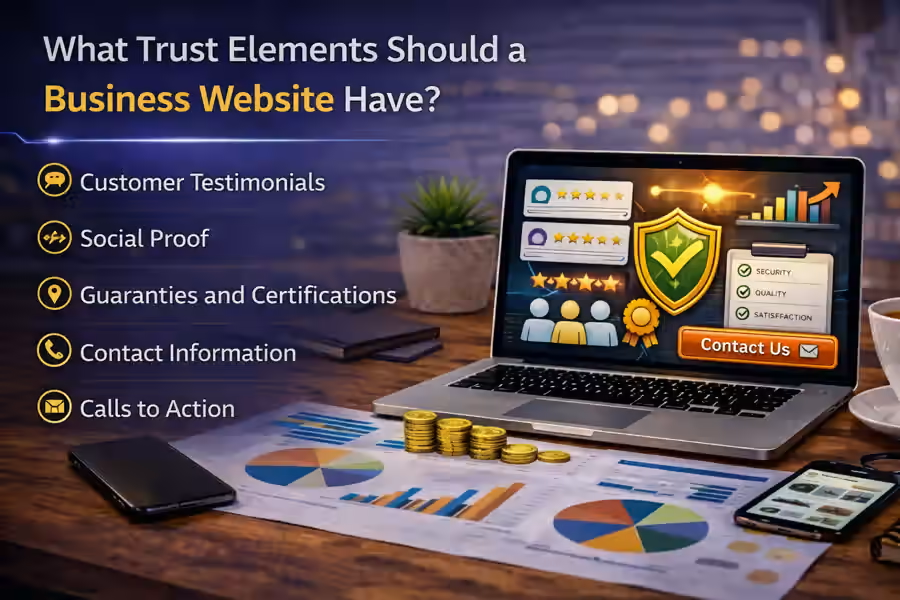
8. Testimonials and social proof
Testimonials are still one of the strongest trust elements on a business website, as long as they are presented naturally.
They work well because they reduce perceived risk. Instead of the company talking about itself, another person validates the experience.
Testimonials become stronger when they include:
- a name;
- a company or industry;
- project context;
- the benefit perceived;
- natural language.
Even one or two well-presented testimonials can help more than several generic comments that do not feel believable.
9. A clear process
Another trust-building element is showing that there is a method behind the work.
When the visitor understands how the process works, uncertainty becomes smaller. This is especially important in digital services, where many companies seem to be selling something abstract.
A business website feels more credible when it explains, for example:
- how the first contact works;
- how needs are assessed;
- what the project stages are;
- what will be delivered;
- how communication takes place.
This reduces doubts and helps the client feel that there is structure and organisation behind the service.
When the website needs to connect forms, CRM tools, automations, or internal systems, technical clarity also reinforces trust. In such cases, it can make sense to work with API Integrations for Businesses.
10. Consistent calls to action
Trust also depends on the way the website invites the visitor to act.
When the CTA is too aggressive, repetitive, or appears too early, it can create resistance. On the other hand, when it appears at the right moment and with the right message, it supports conversion.
Examples of more consistent CTAs for a business website include:
- Request a quote
- Talk about your project
- Receive a proposal
- Book a meeting
It is also worth making sure the context before the button prepares the decision. If you want to go deeper into this, you can connect it with how to improve the conversion of a business website.
11. A simple, low-friction contact form
The contact form is also a trust element.
When it asks for too much information, feels confusing, or looks like too much effort, the visitor may give up. A simpler form usually performs better.
In most cases, it is enough to ask for:
- name;
- email;
- phone number, if relevant;
- message.
The simpler and clearer the form is, the less resistance the visitor feels. This topic can also be explored further in why your website forms do not generate enquiries.
12. Consistency across the whole website
Trust does not depend on one single section. It depends on overall consistency.
For example, a website may have a strong homepage but still lose credibility if:
- the inner pages are weak;
- the tone changes too much;
- the design feels inconsistent;
- visible errors appear;
- the website feels incomplete.
The visitor evaluates the whole experience. That is why building trust means keeping the same level of clarity, professionalism, and consistency across all main pages.
Mistakes that reduce trust on a business website
It is also important to know what damages credibility. Some mistakes appear very often:
Overly generic phrases
When the text explains nothing concretely, the website feels empty.
Too many promises
Exaggerated claims create doubt instead of authority.
Lack of real information
If there is no clear contact information, visible business identity, or context about the company, the visitor hesitates.
Outdated design
Even without understanding technical details, users notice when a website feels old or poorly resolved.
No proof
Without examples, testimonials, or concrete signals, everything depends only on the company’s own claims.
In many cases, it is not one single mistake that destroys trust. It is the sum of many weak signals.
How to review the trust level of your website
A practical way to assess this is to enter your website as if you were a new client and answer these questions:
- Do I quickly understand what the company does?
- Does the website feel professional and up to date?
- Is there clarity about the services?
- Do I feel that there is a real business behind this website?
- Do I see signals that reduce the risk of getting in touch?
- Does the next step feel simple?
If several answers are negative, then the website probably needs stronger trust elements.
Conclusion
Trust elements on a business website do not exist only to improve image. They help reduce doubts, increase credibility, and make conversion easier.
When the visitor feels that the company is clear, organised, and professional, it becomes much easier to move towards contact. On the other hand, when the website communicates uncertainty, vagueness, or lack of structure, even a strong service can lose opportunities.
A business website that generates leads does not depend only on design or traffic. It also depends on how it communicates trust in every detail.
Final CTA
If your website does not clearly communicate who your company is, how it works, and why it is worth getting in touch, it is probably losing opportunities before the visitor even reaches the contact form.