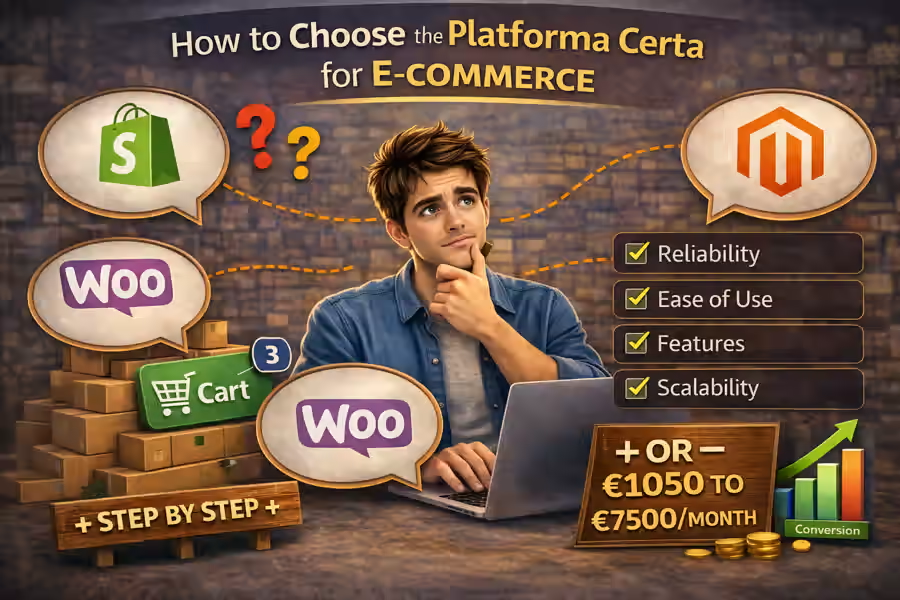
Choosing the right e-commerce platform is one of the most important decisions at the beginning of any online store project. The platform affects website performance, ease of management, integrations, SEO, scalability, and, of course, the store’s ability to sell effectively.
Many businesses start by looking only at price or ease of use. However, this decision needs more careful analysis. A platform that seems simple at the beginning may create limitations later. On the other hand, a more flexible solution may require more setup, but deliver better long-term results.
If you are still at a more strategic stage, it is also worth reading How to Choose the Best Online Store for Your Business, because the platform is only one part of the decision. Store structure, business goals, and the type of catalog also matter a lot.
In this article, we will look at how to choose the right e-commerce platform, which factors to evaluate, and which mistakes to avoid.
Why platform choice matters so much
The platform is the foundation of the online store. It is where you will manage products, process orders, configure payments, edit pages, and support business growth.
If the foundation is wrong, problems appear such as:
- difficulty customizing the store
- technical limitations
- weak SEO
- a poor shopping experience
- difficult integrations
- unexpected costs in the future
That is why choosing well from the beginning can prevent many problems later.
There is no perfect platform for everyone
One of the most common mistakes is looking for “the best platform” as if there were one perfect solution for every business.
In practice, the ideal platform depends on factors such as:
- type of business
- number of products
- budget
- need for customization
- available team
- growth goals
- importance of SEO
- need for integrations
A simple store with a few products may work well on a more straightforward solution. A more strategic project, with focus on growth, content, and SEO, may require a stronger foundation.
Start with business goals
Before comparing platforms, it is important to answer some questions:
- do you want to start selling quickly or build a solid long-term foundation?
- will the store have only a few products or a large catalog?
- will your main focus be paid traffic, SEO, or both?
- do you need a simple store or a more customized structure?
- will you sell in one language or in multiple markets?
Without this clarity, comparing platforms becomes superficial.
Evaluate ease of management
A platform should work well not only for customers, but also for the people who manage the store.
It is important to understand whether it will be easy to:
- add products
- edit descriptions
- manage stock
- follow orders
- update banners and pages
- change prices
- apply promotions
If store management is too technical or too limited, daily operations become slower and less efficient.
Analyze the level of customization
Not all platforms offer the same level of freedom.
Some are more closed but easier to use. Others require more configuration, but allow the store to fit the business more accurately.
At this stage, it is worth asking:
- do you need a more customized design?
- do you want to create specific pages?
- do you need special product or checkout rules?
- do you want to integrate more tools in the future?
If the business needs more control, it is important to choose a solution that will not block future growth.
Think about SEO from the start
Many businesses look first at design and only later think about SEO. That is a common mistake.
The platform directly affects elements such as:
- URL structure
- website speed
- management of meta titles and descriptions
- technical control of pages
- category organization
- integration with content and blog
If the goal includes ranking on Google and attracting organic traffic, this analysis is essential.
Check how the platform handles products and categories
A good e-commerce platform should make it easy to organize the catalog.
It is important to see whether it can manage:
- categories
- subcategories
- product variations
- attributes
- stock
- filters
- internal search
If this part is weak, the store loses organization and the user experience becomes worse.
This point is also connected with How to Prepare Products for an Online Store and How to Structure an Online Store to Sell More, because a good platform should make that organization easier, not harder.
Consider payments and shipping
Another important part is understanding how the platform works with:
- payment methods
- payment gateways
- MB Way
- Multibanco
- cards
- PayPal
- shipping providers
- delivery cost calculation
A platform may look good at first glance, but become problematic if it does not integrate well with what the operation needs.
Pay attention to the real costs
The cost of a platform is not only the monthly subscription or initial price.
It is also important to consider:
- themes or templates
- apps or plugins
- paid integrations
- maintenance
- support
- future customizations
- growth-related costs
Sometimes a platform seems cheaper at the beginning, but becomes more expensive over time. In other cases, a higher initial investment can pay off because of flexibility and a stronger foundation.
This topic is connected with How Much Does It Cost to Create an Online Store for a Business, because the total cost depends a lot on the chosen platform and features.
WooCommerce or Shopify: which one makes more sense?
Two of the most popular options for e-commerce are WooCommerce and Shopify.
In general:
WooCommerce
It may make more sense if you:
- want more control
- value SEO
- need customization
- want to integrate content and blog more freely
- have a more strategic long-term vision
Shopify
It may make more sense if you:
- want to launch faster
- prefer a simpler solution to manage
- do not want to deal with many technical aspects
- need a more direct implementation
If you want to explore this comparison in more detail, see WooCommerce or Shopify: Which Platform Should You Choose for Your Online Store.
The platform should support growth
A platform may work well at the beginning, but fail to support business growth later.
That is why it is important to think ahead:
- will the store grow in number of products?
- will it need automation?
- will there be more content?
- do you want to sell in more languages?
- will you integrate CRM or email marketing?
- can the structure become more complex over time?
Choosing only for the current moment may create limitations within a few months.
Common mistakes when choosing a platform
Some mistakes happen frequently at this stage:
- choosing only based on price
- deciding only based on initial simplicity
- ignoring SEO
- not thinking about growth
- not evaluating day-to-day operations
- choosing without understanding the catalog
- not considering future customization
- making the decision only based on other people’s opinions
Many of these mistakes later create serious problems and are also connected with Mistakes When Creating an Online Store.
When professional support makes sense
If a business does not want to risk making the wrong decision, professional support can be very useful.
A technical and strategic analysis helps determine which platform makes more sense for:
- the business model
- the type of catalog
- the available budget
- the growth goals
- the focus on SEO and conversion
In this context, it may make sense to consider solutions such as WooCommerce Online Store Development or Professional Shopify Store, depending on the type of project and the level of customization needed.
Conclusion
Choosing the right e-commerce platform is much more than comparing surface-level features. It is a decision that affects structure, management, SEO, conversion, costs, and growth.
In practice, the best choice depends on:
- business goals
- type of store
- catalog
- customization needs
- SEO importance
- available resources
- long-term vision
Rather than searching for “the best platform on the market,” the most important thing is finding the best platform for your reality.
FAQ
What is the best platform for e-commerce?
There is no single answer. The best platform depends on the type of business, catalog, budget, customization needs, and growth goals.
Is WooCommerce better than Shopify?
It depends on the project. WooCommerce offers more flexibility and control, while Shopify can be simpler and faster to launch.
Does the platform affect SEO?
Yes. The platform affects structure, speed, technical control, and the store’s ability to be optimized.
Is it worth choosing the cheapest platform?
Not always. A cheaper solution at the beginning can create bigger costs later if it limits store growth or customization.